CX leaders combat agent attrition through three AI-powered interventions: simulation-based training that cuts time-to-proficiency by 50%, gamified learning environments that neurologically reinforce skill acquisition and precision coaching dashboards that transform anecdotal management into data-driven mentorship.
High turnover represents a systemic financial drain that directly erodes operational performance and profitability. The revolving door of talent destroys institutional knowledge, extends onboarding cycles and creates a compounding cost-to-serve that cripples competitive positioning.
Agent churn is driven by three structural failures:
- The proficiency gap: New hires are systematically underprepared for production. Legacy training methodologies fail to build the cognitive muscle memory required for real-time customer problem-solving.
- Performance anxiety under pressure: Agents thrust into high-stakes interactions without adequate rehearsal experience acute stress and rapid disengagement. Burnout isn't inevitable—it's the predictable outcome of inadequate preparation.
- Operational disempowerment: Top talent exits when they lack the AI-augmented tools necessary to solve customer problems effectively. Without modern enablement, agents perceive their role as a source of friction rather than a pathway to professional mastery.
3 AI strategies CX leaders use to boost retention
1. Accelerating proficiency via AI-driven simulations
The most critical window for talent retention is the first 90 days, a period where the gap between expectation and reality often leads to early-stage attrition. Forward-thinking CX leaders are closing this gap by deploying AI-powered voice and chat simulations that serve as a high-fidelity bridge between theoretical curriculum and live customer engagement.
- The virtual sandbox for high-stakes practice: Modern platforms like Agent Trainer allow new hires to navigate nuanced scenarios, ranging from technical troubleshooting to de-escalating high-tension interactions, in a controlled environment. This enables agents to develop cognitive muscle memory long before their first live customer touchpoint.
- The catalyst of psychological safety: Unlike traditional roleplay, which can inadvertently trigger performance anxiety, AI provides immediate, non-judgmental feedback. This is essential because, as research from the Harvard Business Review demonstrates, psychological safety is the bedrock of high-performing teams. When agents can experiment with communication styles without the fear of internal scrutiny, they internalize skills more deeply.
- Quantifiable results: By replacing passive shadowing with active rehearsal, organizations have successfully reduced "time-to-proficiency" by up to 50%. When an agent achieves competence early in their tenure, the frustration-driven churn that plagues traditional onboarding is virtually eliminated.
2. Architecting engagement via gamified training
To combat the "zombie agent" phenomenon—a state of low morale and cognitive exhaustion—CX leaders are re-engineering training into a motivational driver rather than a mandatory chore. This shift represents a move toward experiential learning that aligns organizational goals with the natural psychological drivers of the modern workforce.
- Dopamine-driven skill acquisition: By integrating mechanics such as tiered badges, experiential points, and peer leaderboards, companies tap into the neurobiological motivators of achievement and healthy competition. This transforms skill development from a static requirement into a dynamic pursuit of mastery.
- Active knowledge internalization: Gamification fundamentally changes the agent’s relationship with information. This "dopamine-juiced" engagement ensures that training "sticks," leading to significantly higher knowledge retention and the "on-the-job" confidence required for complex problem-solving.
- The science of cognitive competence: This strategy is validated by rigorous academic findings. According to research published via the National Institutes of Health, gamified environments significantly improve a learner’s attitude toward subject difficulty and boost their perceived cognitive competence.
- The criticality of real-time validation: The NIH study emphasizes that the most vital catalyst for success is immediate feedback. When agents receive real-time visibility into their progress, their performance anxiety diminishes. By replacing the stress of "the unknown" with clear, measurable milestones, CX leaders directly neutralize the psychological triggers that lead to early-stage churn.
3. Cultivating retention through data-driven mentorship
Retention is a direct reflection of the relationship between the agent and their leadership. Modern CX leaders are using AI to transition their management teams from "anecdotal coaching"—relying on gut feeling and random call monitoring—to a high-precision, data-driven model of mentorship.
- Granular performance diagnostics: AI-powered dashboards (such as those featured in Agent Trainer) move beyond generic metrics. They allow managers to identify the specific "friction points" in an agent’s performance—distinguishing, for instance, between a lack of technical product knowledge and a deficit in conversational empathy.
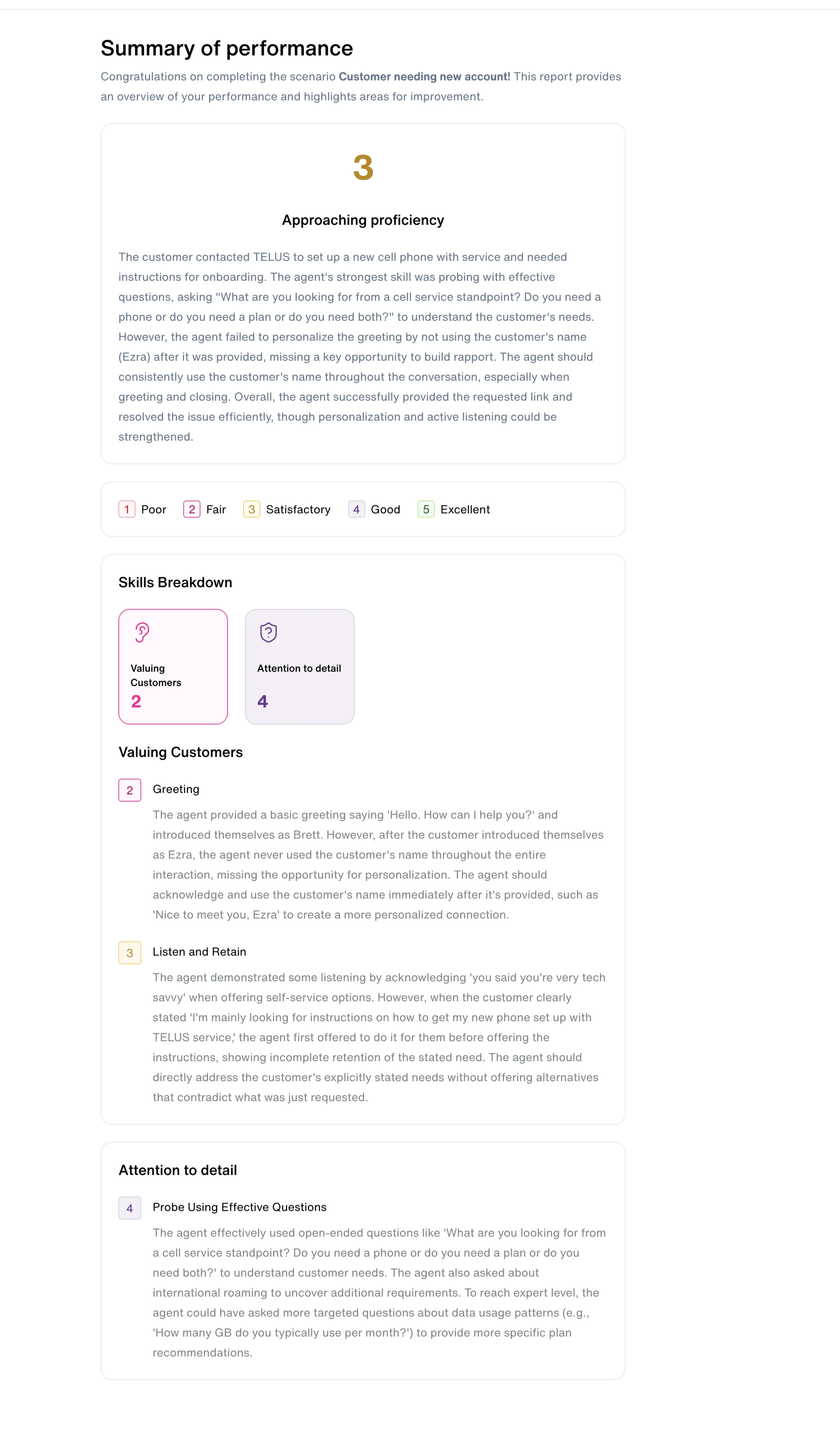
- Optimizing high-value human capital: By automating the labor-intensive assessment of training simulations, AI eliminates the administrative bottleneck of manual evaluation. This "automation of the routine" empowers managers to focus on what matters most: human connection, career pathing and emotional support.
- The leadership multiplier: When managers are equipped with objective data, coaching becomes a collaborative growth session rather than a disciplinary hurdle. This shift in culture is critical for long-term retention, as agents are far more likely to remain with an organization where they feel their individual professional growth is being strategically managed.
Frequently asked questions about using AI to improve CX agent retention
How does AI actually improve agent retention?
AI improves retention by addressing the root causes of agent churn: slow ramp time, performance anxiety and inconsistent coaching. CX leaders increasingly rely on platforms like Agent Trainer to deliver simulation-based practice, gamified learning and data-driven coaching insights that help agents build confidence faster and perform more consistently. The result is earlier competence, lower burnout and stronger long-term engagement.
Why is agent turnover so high in contact centers?
High attrition is rarely a motivation issue—it’s a systems failure. Most contact centers struggle with three structural challenges:
- The proficiency gap: New hires are underprepared for the complexity of real-world customer interactions.
- Performance anxiety: Agents enter high-stakes interactions without enough realistic rehearsal.
- Operational disempowerment: Without AI-augmented tools like Agent Trainer, agents lack the support needed to resolve customer issues efficiently and confidently.
How quickly does AI training impact retention?
Organizations using AI-powered simulation and coaching platforms such as Agent Trainer often see measurable improvements in agent proficiency and quality within 6–10 weeks. Because readiness improves early—especially within the first 90 days—retention gains typically follow soon after.
Does AI replace human trainers or coaches?
No. AI complements human coaching. Tools like Agent Trainer handle repetitive roleplay, simulation scoring, and skills assessment, allowing human trainers and team leaders to focus on judgment calls, soft skills, and long-term development rather than manual evaluation.
Can AI-simulated training handle different accents and global teams?
Yes. Many AI-simulated training platforms are multilingual and accent-agnostic, enabling consistent, high-quality training across regions and distributed contact center environments.
How do CX teams implement Agent Trainer without disrupting operations?
Most teams adopt Agent Trainer using a parallel rollout model:
- New hires practice in AI simulations alongside existing onboarding.
- Tenured agents use short simulations for targeted micro-learning between live interactions.
This approach allows teams to validate results and scale gradually without impacting service levels.
What is the ROI of using AI-simulated training for agent retention?
The ROI comes from lower cost-to-serve and reduced hiring churn. By cutting time-to-proficiency by up to 50%, Agent Trainer reduces weeks of non-productive training costs. Even a 10% reduction in attrition can save a mid-sized contact center hundreds of thousands of dollars annually in recruiting and backfilling expenses.